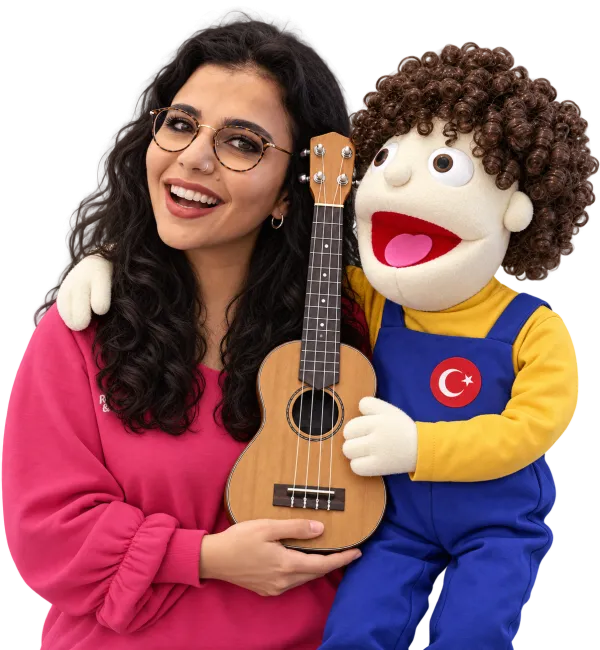
Teaching children Turkish proverbs and idioms
How to introduce Turkish proverbs and idioms to a child growing up abroad: age-based examples with English meanings and 5 short activities for home.


Short answer: Correcting every mistake on the spot can reduce a child's wish to speak. What works better is repeating the correct form in a natural reply and first showing interest in what they want to say.
Children growing up with two languages may mix the rules of both, or switch to the other language when they can't find a word. This is common while learning a language and is not, on its own, a sign of a problem.
If your child says "Dün parka gittik ve ben salıncak bindim", reply "Salıncağa bindin mi? Ne güzel! Yüksek mi sallandın?" They hear the correct form, and the conversation keeps going. You can call this "reflecting back".
If your child says a word in English (or another language), use the Turkish word naturally in your reply. Instead of "Say it in Turkish!", keep the conversation going in Turkish. More on this: My child understands Turkish but answers in English
You can ask the teacher for one or two mistakes your child often makes and how to support them at home. That way, at home you aim at a few things, not everything. For other decisions, see the Parent Decision Centre.
How to introduce Turkish proverbs and idioms to a child growing up abroad: age-based examples with English meanings and 5 short activities for home.
Easy Turkish riddles with answers and English meanings for children growing up abroad, plus age tips and a simple pattern for making their own.
Short, easy and funny Turkish tongue twisters for children growing up abroad, with English meanings, age tips and 5 ways to turn them into a game.
Choose a teacher and plan a gift intro lesson, or talk with our education team first.