My Child Does Not Want to Speak Turkish: How Can I Help Without Pressure?
Reluctance is information, not a label. Find the hard moment, lower the demand and reconnect Turkish with subjects and people your child cares about.

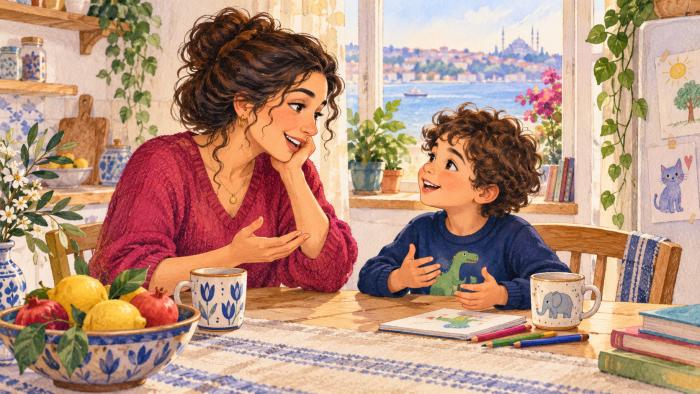
You ask a question in Turkish. Your child clearly understands, then answers in English. This does not mean that Turkish has disappeared. It tells us that understanding is currently easier than producing words, and that English may be the faster or more comfortable response language.
Your child already has something important to work with: meaning. They recognise words, follow the conversation and know what is being asked. Speaking asks for an extra step: finding the word, building the sentence and feeling safe enough to say it. Our first goal is not to turn every English answer into a correction. It is to make that extra step feel manageable.
Choose one predictable moment: preparing breakfast, packing a school bag or choosing pyjamas. Use the same five to eight expressions for a week. Repetition inside a real routine is more useful than a long list that appears once. If your child answers in English, continue warmly and include the Turkish phrase in your reply.
A teacher can create reasons to speak through pictures, games, choices and shared tasks. At Roots & Talks, live lessons are 25 minutes and the starting point is adjusted to the child’s age and current use of Turkish. The lesson is not a pass-or-fail speaking test. You can read how the lesson process works or meet our Turkish teachers for children.
If Turkish answers are rare, begin with one small routine and observe which subjects invite the most participation. When you want a teacher to see that starting point, you can plan a 25-minute gift intro lesson. You remain free to decide what happens afterwards.
Reluctance is information, not a label. Find the hard moment, lower the demand and reconnect Turkish with subjects and people your child cares about.
Choose a teacher and plan a gift intro lesson, or talk with our education team first.