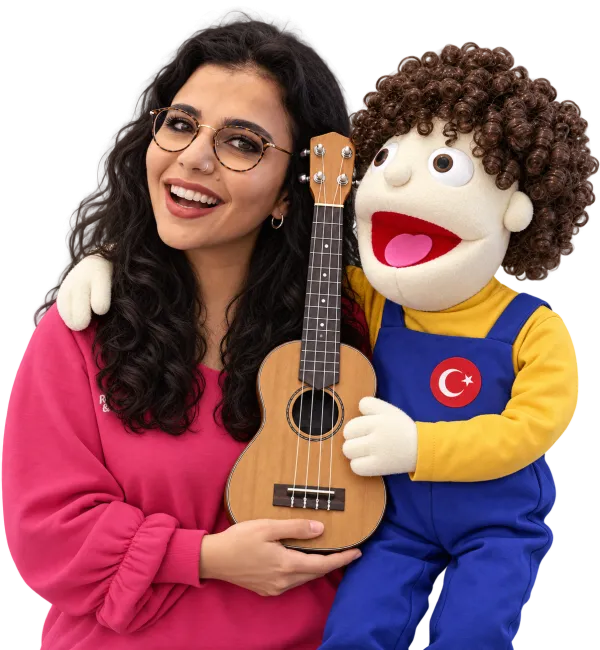
Music and Turkish with Children: Listen, Sing and Talk Together
Music can be something you and your child enjoy together. Trying a rhythm, listening to a favorite song or exploring an instrument does not need a promise of higher grades. Your child’s interest, a suitable experience and the time you share are worthwhile starting points.
What does the research establish?
It is not accurate to present music lessons as a guaranteed route to better mathematics, reading or general cognitive ability. In their 2020 multilevel meta-analysis, Sala and Gobet found no overall cognitive or academic transfer effect after accounting for study-design quality. This does not mean music lacks value; it means its value should not depend on promising success in unrelated subjects. Read the study and its scope.
Keep expectations connected to the activity
Following a rhythm, trying a section again and taking turns while playing together are experiences within music practice. Do not assume that a child will automatically apply them in every other setting. A shared activity does not have to become a test or a comparison with other children.
If your child wants to try an instrument, you can discuss the sound they like, the teacher’s approach, the practice environment and the time your family can offer. There is no need to conclude that every child must start an instrument early. Interests may change; listening or singing together can also be your shared activity.
Let a song open a small Turkish conversation
The following are original conversation ideas for families, not a teaching program validated by the study. After choosing a song, try just one prompt:
- Ask “Bu bölüm hızlı mı, yavaş mı?” — “Is this part fast or slow?” — and listen to the two options together.
- Let your child choose a sound. Add your own thought: “Bu ses bana yağmuru hatırlattı” — “This sound reminded me of rain.”
- Ask “Bir daha hangi kısmı dinleyelim?” — “Which part shall we listen to again?” — and let your child choose.
If your child responds in another language, you can respond to the idea they expressed. You do not have to turn every word into a repetition exercise. Lower the volume if it feels uncomfortable, and choose another shared activity if your child does not want to continue.
Make a small plan that fits your family
This week, for example, choose one song, talk about a favorite part and decide whether to return to it next time. There is no need to count words or award performance points. Our guide to making room for Turkish at home offers other ways to include shared activities in everyday life.
Source and wording update: 27 October 2026. Earlier statements implying guaranteed academic success or lifelong developmental outcomes have been removed. This article is not an individual developmental assessment.
Continue from here
Turkish on family visits: small steps that give your child a voice
How to prepare a family visit so your child speaks Turkish with relatives without feeling tested: shared tasks, age-by-age ideas and what to do if they go quiet.
Turkish conversation with picture books: look together before you read
How to turn a picture book into a Turkish conversation: choosing the book, looking at the pictures and short dialogue ideas. A flexible start for families of 4–10 year olds.
Take the first step for your child
Choose a teacher and plan a gift intro lesson, or talk with our education team first.